AllNewsChannels.com

Trump_Grants_Iran_10-Day_Extension_for_Sanctions_Decision

Trump Grants Iran 10-Day Extension for Sanctions Decision

by

in

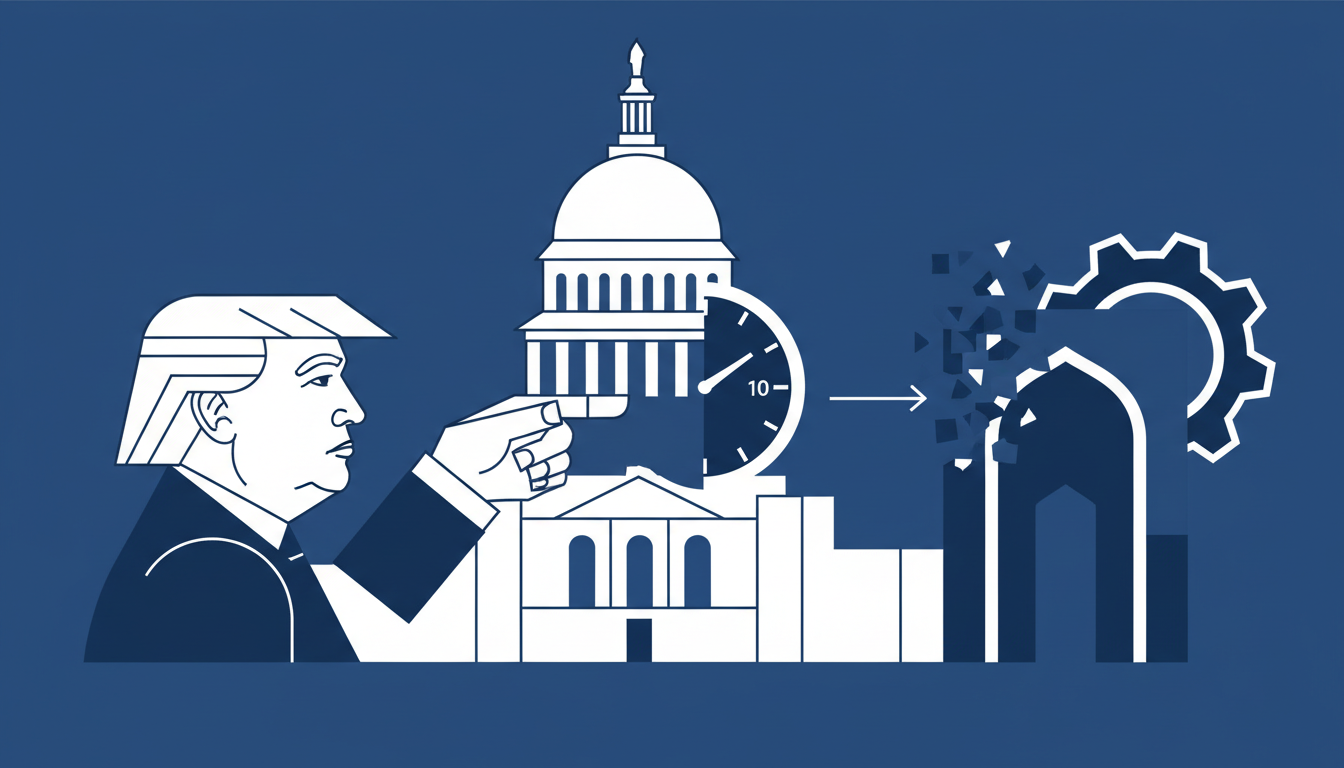
President Donald Trump has granted Iran an additional 10 days regarding a critical deadline, sparking discussions on the potential strategic and economic consequences of the extension. The move introduces a brief period of uncertainty as international observers weigh the impact on regional stability and sanctions enforcement. While the extension provides a temporary window for diplomatic considerations, analysts are examining the potential costs of the delay and its influence on broader geopolitical tensions and international relations in the Middle East.

  • The United States has officially extended a deadline involving Iran by 10 days.
  • The delay impacts the current timeline for diplomatic negotiations and the potential implementation of further measures.
  • Geopolitical analysts are assessing the economic implications and the risks associated with continued regional uncertainty.
  • The decision comes amid ongoing international scrutiny of Iran’s nuclear activities and its influence across the region.
  • Observers are questioning whether the 10-day period will lead to a diplomatic breakthrough or simply postpone further confrontation.

DW News is a global news TV program broadcast by German public state-owned international broadcaster Deutsche Welle (DW).

AllSides Media Bias Rating: Center

https://www.allsides.com/news-source/deutsche-welle-media-bias

Official website: https://www.dw.com

Original video here.

This summary has been generated by AI.


Comments

5 responses to “Trump Grants Iran 10-Day Extension for Sanctions Decision”

  1. The Hormuz was already open before the war 😂😂

  2. 🌮🌮🌮🌮🌮🌮🌮🌮🌮😂

  3. Make Nord Stream Great Again 🇷🇺

  4. If the US decides to take over the Iranian oil export island of kharg , it could spark further retaliation from Iran on all the gulf-states refinary capacity. And that would put us ALL people in a downward spiral of SEVERE economic downturn , everywhere

  5. From a Chinese TikToker :
    ——
    This is absolutely upside-down.

    Completely upside-down. We're watching Iran hunt down U.S. military personnel across the Middle East—truly a "once-in-a-lifetime" series. According to the latest statement from the spokesperson of Iran's Armed Forces Central Command, all U.S. military bases in the Middle East have been destroyed, and some U.S. commanders and soldiers have fled their bases and are now hiding in external locations. Iranian armed forces are actively conducting search operations. Do you understand the weight of that statement? U.S. troops are being pursued in the Middle East, and Iran has even begun publicly appealing to civilians in regional countries, urging them to provide intelligence.

    This isn't a symmetrical military standoff. This is Iran using ground-level manhunts to signal to everyone who actually holds power in this region now. But if you think this is just about battlefield dynamics, you're underestimating the scope of this contest. What's really unfolding now is an information war. The rhetorical clash between the U.S. and Iran has reached a fever pitch. Why? Because both sides are laying groundwork for the same objective: an imminent large-scale ground operation. And the tactics of this information war are exposing each side's true hand.

    On the U.S. side, outlets like The Wall Street Journal keep floating narratives that Gulf monarchs are about to join the fight—claiming these "princes" are desperately urging the U.S. to keep going. Do you buy that? Do you believe it? This is classic coercive framing: dragging allies onto the hot seat and forcing them to pick a side. But the real question is: are Gulf states actually willing to jump into this fire?

    Iran's countermeasures are even sharper. On one hand, Tehran has stated that as long as you're not an enemy of Iran, you're free to pass through the Strait of Hormuz—yet in practice, passage is effectively impossible. The brilliance of this messaging lies in how it fractures opposition: whoever ignores Iran's position invites trouble; whoever aligns with Iran stays out of the crosshairs.

    On the other hand, Iran has directly posed a devastating question—arguably the most uncomfortable point in this entire episode: If Israel invades you in the future, will the Americans fire a single shot on your behalf? This isn't hypothetical. It's a precedent that's already happened. Israel bombed Doha, Qatar's capital. Did the U.S. defend Qatar then? No. Not a single shot was fired. Iran is using this question to dismantle America's credibility architecture in the Middle East. You want to rally Gulf states against me? Fine—but let them think clearly: when you truly need America, will they actually stand by you?

    The current predicament of Gulf states can be summarized in one phrase: Too far from heaven, too close to Iran. For the U.S., if this war becomes unwinnable, it can simply withdraw from the Middle East, retreat to the Americas, and continue as a regional hegemon. Israel is also geographically distant from Iran, with some strategic buffer space. But Gulf states? They can't pack up and leave. Iran is right next door.

    More critically, the two sides' strategic assets are completely asymmetrical. After two years of continuous conflict with the U.S. and Israel, Iran's high-value ground targets have largely already been degraded. It's the barefoot fighter who fears no one wearing shoes. Gulf states, however, are different: their most valuable assets—energy infrastructure, ports, airports, financial hubs, urban systems—are all exposed, concentrated, vulnerable, and inadequately protected. To date, Iran's strikes have remained relatively restrained, primarily targeting military nodes linked to U.S. forces. Iran hasn't flipped the table—not because it can't, but because it hasn't reached that threshold yet. But can Gulf states absorb the cost of having the table flipped? If conflict engulfs their core assets, the social contract underpinning their rulers' wealth and stability collapses. If their foundational assets are destroyed, they understand the consequences better than anyone.

    So what are we witnessing now? Iran is shifting from defense to offense. On the 25th, Iran's Press TV cited a senior official stating that Tehran has rejected the U.S. ceasefire proposal and instead presented five counter-conditions:

    Halt all aggression and assassinations;

    Establish mechanisms to guarantee that war is never imposed on Iran again;

    Explicitly end the war across all regional fronts;

    Formal recognition of Iran's sovereignty over the Strait of Hormuz;

    [Implied] Acceptance that the terms of war's conclusion will be dictated by Iran, not by external timelines.

    Iran's wording is unequivocal: any ceasefire must presuppose full acceptance of Iran's conditions. No negotiations will occur until then. The end of this war will be determined by Iran—not by Trump's preferred schedule. This isn't a negotiating posture. This is a victor's ultimatum.

    Meanwhile, on March 26, at a fundraising dinner, Trump was still claiming that negotiations with Iran were ongoing, that Tehran was eager to reach a deal but too afraid to say so outright, and that the U.S. had "won too decisively" in Iran. But think about it: if talks were genuinely happening, why would Trump say Iran "doesn't dare admit it"? That very phrasing suggests there are no direct communication channels. Trump's so-called "negotiations" are merely unilateral signaling to external audiences. Iran, meanwhile, isn't even entertaining talks. On one side: Iran actively hunting U.S. personnel. On the other: the U.S. President claiming at a donor event that "we've won big." Place those two images side by side—which one do you believe?

    The Middle East today sits in the calm before the storm. The real large-scale ground campaign is still ahead. But before that unfolds, everyone is watching one critical variable: How much credibility does the U.S. still command in the Middle East? When push comes to shove, will Gulf states stand with America—or with the preservation of their own assets? Amid this complex, volatile landscape, what will the answer be?
    ——

Leave a Reply

Your email address will not be published. Required fields are marked *