BODY:
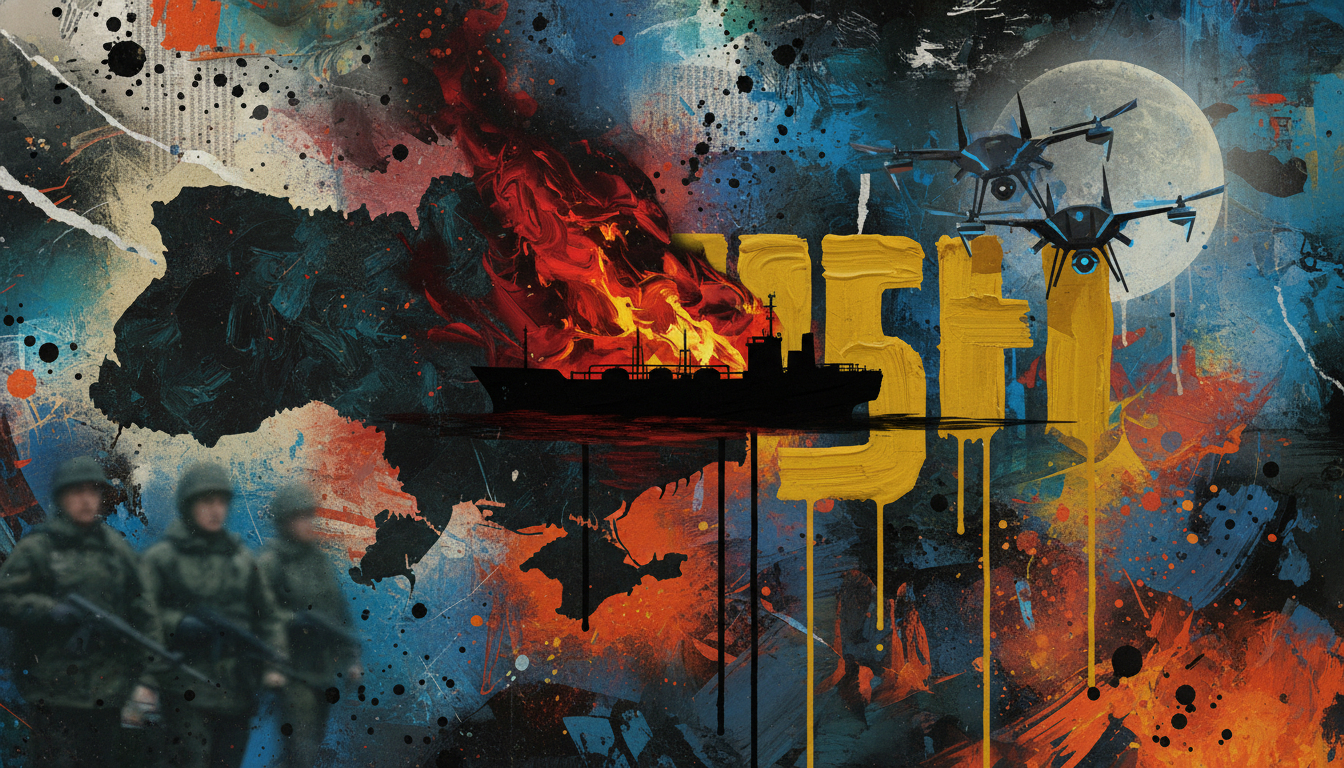
Global geopolitical stability continues to face severe tests today as interconnected conflicts disrupt international markets and maritime security. In the Middle East, amid the ongoing closure of the Strait of Hormuz, an Iranian strike on a Kuwaiti tanker has intensified fears of continued disruption, driving US gas prices past $4 a gallon. Meanwhile, the protracted war in Ukraine has drawn direct involvement from North Korean troops, marking a dangerous new phase of the conflict as US lawmakers face ongoing domestic gridlock over critical defense funding.
Middle East Escalation, Iran, and Global Energy Security
Already at a historic threshold following Tehran’s recent unprecedented aerial assault on Israel, tensions involving Iran continue to threaten global energy markets and international shipping lanes. The ongoing crisis deepened following a direct Iranian strike on a Kuwaiti-owned commercial tanker. According to Bloomberg, this maritime incident coincides with reports that former US President Donald Trump is evaluating a potential withdrawal of US forces from active conflict zones in the region. However, a US military drawdown without a diplomatic resolution could trigger severe volatility in global equities, with another Bloomberg report highlighting the risks that a continued closure of the Strait of Hormuz poses to stock markets and inflation control.
The immediate economic impact is already being felt domestically in the United States, where the national average price for gasoline has officially exceeded $4 per gallon. A separate Bloomberg analysis notes that Trump has signaled a cautious approach to large-scale military escalation, yet simultaneously issued aggressive warnings to Tehran. Expanding on his recent suggestions to target Iranian oil hubs, he recently threatened to target Iranian power supplies and infrastructure if regional hostilities continue, according to the BBC. Furthermore, Trump has fundamentally challenged the traditional US role as the guarantor of international maritime security. The BBC reports that he directed nations such as China and Japan to secure their own oil shipments through the Persian Gulf without relying on uncompensated American protection.
Strategic vulnerabilities remain at the forefront of the ongoing crisis. Analysts speaking to Channel News Asia warned that any military action targeting Iran’s Kharg Island—the primary hub for the country’s crude exports—would act as a catalyst for a massive oil price rally and wider regional warfare. Consequently, international stakeholders are actively considering the use of joint military force to reopen the Strait of Hormuz and deter further aggression against commercial vessels, as reported by DW. To insulate against these ongoing supply shocks, DW notes that energy experts are urging the strengthening of strategic petroleum reserves and faster transitions to diversified energy infrastructure.
Amidst these regional dynamics, Israeli Prime Minister Benjamin Netanyahu declared that the broader military campaign against Iranian-backed forces has passed the halfway point. According to the BBC, Netanyahu stated that Israel is systematically dismantling the command structures of opposing groups to ensure long-term regional stability. Looking for a diplomatic off-ramp, foreign ministers from China and Pakistan met in Beijing to issue a joint call for an immediate ceasefire and enhanced strategic coordination regarding the ongoing situations in Iran and Gaza, as covered by Channel News Asia.
Israel-Palestine Conflict and Regional Spillover
Within Israel, adding to ongoing domestic friction over security and wartime policies, intense outrage has erupted following the ministerial committee’s preliminary approval of legislation that would introduce the death penalty for Palestinians convicted of terrorism. France 24 reports that the bill, spearheaded by the far-right Otzma Yehudit party, targets killings motivated by nationalist sentiment. The advancement of this legislation immediately sparked chaotic scenes in the Knesset. As documented by DW, the families of Israeli hostages violently protested the bill, arguing that its inflammatory timing directly endangers their captive relatives by inviting retaliatory executions by militant groups.
Regionally, the multi-front kinetic conflict continues to breach borders with tragic consequences. Amid Israel’s ongoing ground operations and bombardments in southern Lebanon, three United Nations peacekeepers serving with UNIFIL were killed during sustained cross-border military exchanges. France 24 notes that the fatalities have triggered urgent international demands for thorough investigations and immediate assurances regarding the safety of observers stationed along the Blue Line.
The Russia-Ukraine War
The protracted war in Ukraine is confronting dangerous new escalations and waning Western momentum. North Korea has deepened its direct involvement in the conflict by supplying Russia with troops and military hardware. According to DW, North Korean military engineers are actively deploying missile systems in occupied Ukrainian territories, utilizing the theater as a live combat environment to test their weaponry against Western defense systems. Recent intelligence confirmed that at least six North Korean military officers were killed during a missile strike near Donetsk.
Concurrently, Ukraine faces the threat of reduced international backing as Washington continues its heavy focus on crises in the Middle East. A DW report details how a $106 billion supplemental aid package for Kyiv remains stalled in the US Congress due to Republican demands for domestic border security reforms and the separation of funding for Israel. This ongoing geopolitical shift threatens to leave the Ukrainian military under-resourced during a static, “positional” phase of the war. Despite these challenges, European Union officials stood beside Ukrainian President Volodymyr Zelenskyy to commemorate the second anniversary of the liberation of Bucha. France 24 covered the ceremony, where leaders memorialized civilian victims and renewed pledges to prosecute Russian war crimes.
US Domestic Politics, Economy, and Society
In Washington, political and economic pressures continue to mount. Amid eleventh-hour negotiations to secure long-term government funding, the Biden administration has formally requested that Congress cancel its scheduled recess to pass critical budget resolutions and stalled national security measures, according to Bloomberg. Meanwhile, as nationwide protests continue over recent Supreme Court rulings on presidential immunity, former President Donald Trump has launched rhetorical attacks against Supreme Court Justices ahead of potential legal battles surrounding his vow to end birthright citizenship—a policy fundamentally protected by the 14th Amendment, as analyzed by France 24.
On the economic front, former Biden energy advisor Amos Hochstein issued a stark warning regarding a worsening US energy crisis. Speaking to Bloomberg, Hochstein pointed to persistent global maritime volatility, limited domestic refining capacity, and a lack of infrastructure investment as primary drivers of incoming fuel availability issues. Despite these economic headwinds, major US stock indices, including the S&P 500 and Nasdaq, managed a final-day rally driven by strong tech earnings, though Bloomberg notes the broader markets still closed the month in negative territory due to ongoing inflation concerns.
In societal developments, a survivor of Jeffrey Epstein’s abuse, Juliette Bryant, spoke out against the sensationalism surrounding unsealed court documents. According to the BBC, Bryant criticized the media and politicians for treating survivors as political pawns while prioritizing high-profile celebrity names over actual justice and healing. In a similar vein of seeking recognition, 60 Minutes featured the widows of American Airlines Flight 5342, who are actively campaigning for a permanent memorial and greater public acknowledgement of the tragic aviation disaster that upended their lives. On an infrastructural note, Bloomberg reports that construction is advancing on Atlanta’s massive $5 billion Centennial Yards project, aiming to transform the 50-acre “Gulch” district into a dense, mixed-use hub in time for the 2026 FIFA World Cup.
Global Geopolitics and Economics
The BRICS alliance continues its assertive expansion as a counterweight to Western-dominated financial systems. DW reports that the coalition, which recently integrated Egypt, Ethiopia, Iran, and the UAE, now represents roughly 35% of the global economic output. Despite enduring border disputes and political rivalries between major players like China and India, the bloc remains unified in its pursuit of alternative payment systems to bypass the US dollar and Western sanctions.
Conversely, following the recent total collapse of its national electrical grid, the nation of Cuba continues to reel from what is considered its most acute economic crisis in decades. According to DW, the ongoing US trade embargo and Cuba’s designation as a state sponsor of terrorism have severely crippled international banking and shipping for the island. Despite recent US measures to ease oil blockade restrictions, the resulting fuel and currency shortages have led to rolling daily blackouts lasting up to 18 hours, widespread scarcity of the subsidized “canasta básica” food rations, and significant public demonstrations in cities like Santiago de Cuba.
Science, Technology, and Climate
Building on recent international alarms over the military’s use of predictive AI for combat target identification, the theater of modern warfare is experiencing a further paradigm shift through the integration of artificial intelligence in drone technology. As detailed by 60 Minutes, autonomous AI drone swarms can now communicate natively to identify targets and execute missions collectively without a human operator link, rendering traditional electronic jamming obsolete and raising profound ethical concerns regarding autonomous lethal force.
In aerospace, NASA is officially entering final preparations for the Artemis II mission. The BBC reports that four astronauts will embark on a 10-day trajectory around the Moon, marking the first crewed lunar mission in over 50 years and a critical test for the Orion spacecraft’s life-support systems. Back on Earth, drone technology is advancing meteorology. Researchers are flying rugged Caelus drones directly into the blind spots of supercell thunderstorms to collect real-time data on temperature and pressure, an initiative the Wall Street Journal notes is aimed at drastically improving tornado forecasting accuracy beyond the current 14-minute lead time.
Climate change continues to dramatically reshape the physical environment. In countries like France, alternating periods of severe drought and heavy rainfall are causing a geological “shrink-swell” effect in clay-rich soils. France 24 highlights that this phenomenon is causing immense structural damage to residential foundations, straining national insurance systems. Conversely, the warming climate is opening new commercial opportunities in the Arctic. Channel News Asia reports that the rapid melting of polar ice is booming Finland’s specialized icebreaker industry as nations race to establish influence over emerging northern maritime corridors. Meanwhile, managing energy consumption remains a priority in urban centers like Singapore, where Channel News Asia observes that condominium management corporations are aggressively installing solar panels and LED lighting to combat volatile global electricity prices.
Global Society, Law Enforcement, and Culture
Joining recent international regulatory actions such as Indonesia’s youth social media restrictions, Australia has enacted landmark legislation banning children under the age of 16 from using social media platforms. The law forces tech giants to implement robust age-verification technologies or face fines up to AU$50 million. However, analysts speaking to Channel News Asia caution that the true psychological and societal impacts of this ban will not be measurable for several years.
In Europe, Italian authorities have launched a massive investigation following a high-profile art heist. According to the BBC, thieves successfully bypassed gallery security systems to steal historical masterpieces valued in the millions of euros. Additionally, the BBC confirmed the dismissal of veteran radio presenter Scott Mills, terminating his contract effectively immediately following an internal review of allegations concerning a historic relationship. In the Caribbean, economic development moves forward as preliminary site clearing begins on the Azul Destinations project in the Bahamas. Channel News Asia reports that the Long Island project is advancing to secure local employment despite ongoing environmental assessments.
Sports and Entertainment
In a major cultural milestone for the region, Bangkok has been selected as the host city for the inaugural Asian edition of the Eurovision Song Contest. Set for November, France 24 notes that the event will adapt the deeply successful European format to highlight diverse musical talent across the Asian continent. In sports, Singapore’s national football team successfully concluded its Asian Cup 2027 qualifying campaign on a high note, securing a disciplined 1-0 victory over Bangladesh, according to Channel News Asia.
This summary has been generated by AI. Please click the links to go to the original articles.
Leave a Reply